Showing posts with label Remo. Show all posts

5 Apr 2011

Project 2

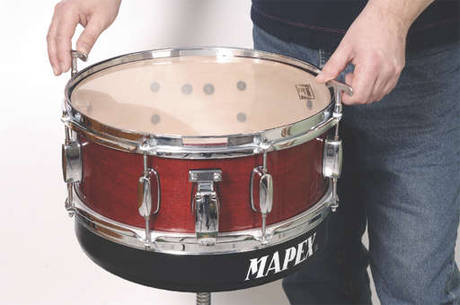
This morning I received a parcel in the post - inside was a new drum head for the project snare/tom. Because I'm turning a tom into a snare I needed to change the bottom head from a regular resonant head (clear) to a snare hazy head. This means the snare wires will resonate properly on the new, thin head and create that loud 'crack' sound. I ordered a Remo Ambassador hazy and here it is.

 Now I'm just waiting on a new bottom hoop and snare wires. The hoop is a 12" 5 lug snare hoop, which means it will have two slits in the metal to allow the snares to pass through. (You can see an example of what I mean here.) As for the snares, they're 12" 16 strand wires. Basically, the more wires you have the more 'snarey' your drum sounds. Bigger drums, like a standard 14" snare, tend to have either 20, 24, or even 42 wires, but because this is a 12" I went for something smaller to fit the drum. Hopefully everything should arrive in the next few days and I can really start making some progress.

4 Apr 2011

Project

A little aside from tips and guides here, but I thought I would share my new project.
I figured it'd be interesting to try and convert an old tom into a snare drum. Not only does this give me a shiny new snare, but it also means I get to learn (and, therefore, you also do) more about how wooden snare drums work.

Snare drums are more commonly made of metal. This tends to give them more of a steel-y crack. However, wooden snare drums are just as good, and offer a slightly warmer tone. I own two metal snares (a cheap budget one and a vintage Premier) and one wooden snare (an old Remo - they don't just do drum heads). I love how the Remo sounds, and wanted a bit more of this sort of thing.

So, with the help of the internet, I tracked down an old Gretsch tom and decided this would be my project.
It arrived today, so here are the 'before' photos.

 Gretsch Catalina Club Tom, 12 x 7 inches, in Silver Sparkle with Black Stripe.
 The tom features the Gretsch Mini GTS suspension system, which suspends the drum by the rims, not by the shell or in a snare stand.
Close up of the badge and sparkly finish.
It came fitted with a well used Evans EC2 SST head.

The tom has a bit of damage - the usual scratches and bumps you'd expect with a drum that's been used for a while - but I aim to replace some of the hardware (the lugs are my main target, and the hoops will have to be changed to allow for snares). I'll also be drilling in holes to mount the snare strainer and butt plate and, if needs be, filing in snare beds. Right now I'm waiting on a Remo Ambassador hazy head, and looking for suitable snare wires and hardware. In between the other posts here about drum kits in general, I'll be updating on the progress of this tom/snare. I hope you enjoy it.

2 Apr 2011

Heads/Skins

One of the easiest ways to improve the sound of your kit is with new drum heads. Most beginner kits come with no-name budget heads that sound fairly plain. However, once you've been playing for a while and are looking to improve your sound, those old heads should be the first things to go.

For those who don't know, drum heads (or skins, whichever) are the part of a drum you hit with the stick. Most modern drums have a head on the top and bottom of the drum (See Phil Collins' kit for an example of drums with just one on the top). The top head, the one you strike, is called the batter head. The one underneath is called the resonant head.

Head types can vary greatly. Generally, there are two finishes - coated and clear. Clear heads tend to have more sustain and a brighter sound. Coated heads give more impact and less ring. Some companies, like Remo, offer things like suede finish, fiberskyn and skyntone. These are really just a variation on coated heads, and offer slightly different sound qualities depending on what you're looking for.
Snare heads are slightly different, in that the batter can be the same as any on your toms (if that's the sound you're after) but the resonant head has to be completely different. A snare bottom head is called a hazy drum head. It's micro-thin (3-mil, usually) and this is what the snare wires resonate against to give you that 'crack' sound when you hit your drum. You don't use regular resonant heads on your snare, and neither do you use a hazy on your toms.
Bass drum heads are also slightly different to other heads. The batter head (where the pedal beater hits the drum) is often heavily muffled. This reduces ring and gives a nice thud sound. You can do this by either putting a small pillow inside your drum, or by using specially muffled heads (or both, as I do). The resonant head will sometimes have a small hole (a port) cut in the front. This makes it easier for a microphone to capture the sound because it can be placed almost inside the drum, and also helps with air flow.


As a general rule, I like to use coated batter heads and clear resonant heads. I like to think this gives me a nice balance of attack and sustain. I tend to favour Remo heads (although Evans and Aquarian are the other big names and I have nothing bad to say about either), and currently use a coated Ambassador batter head on my snare with a Hazy Ambassador underneath. I also have clear Ambassador resonant heads on my toms, with Ebony Pinstripe batters. Aside from the fact that I think black heads look nice on my kit, Pinstripe heads (drum heads made with two layers and a ring reducing agent) give much less sustain and I like the punchy sound they give. The Ebony finish makes this even more pronounced. For my bass drum I use an Aquarian Super-Kick II on the batter side and a ported coated white head on the front.

Each of the aforementioned companies have really useful websites with comparison charts and sometimes sound files to help you pick your drum heads.
http://www.remo.com/
http://www.aquariandrumheads.com/
http://www.evansdrumheads.com/